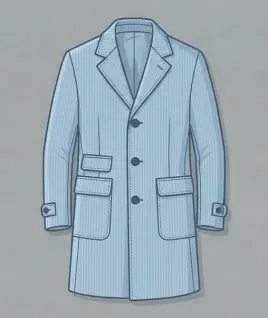
Choosing the right fabric for an overcoat is very important as it determines how warm and lightweight your coat is going to be apart from influencing its longevity as well.
For colder trips north, heavy fabrics like Pure Melton wool and Kashmiri Pashmina can be considered. However, winters in Delhi NCR being short, sharp and predominantly dry call for lighter options like Pure wools, poly-wool blends that can easily hold the structure of the garment.
Reversible coats are made from double-faced woolen fabrics. The term ‘double-faced’ denotes two finished faces on the fabric. Both faces are woven together to make a single fabric. Hence, there is no wrong side and no need for a lining.
Cutting and stitching a reversible coat is challenging as every single stitch has to be drafted twice – one for each face. Though, the results are rewarding as it gives the wearer the luxury of two coats, one formal and one casual, for office and weekend wears respectively.
Once the fabric is decided, we discuss about the type of collar, pockets, fastenings etc. Most bespoke coats are made with a standard width of 70 inch as it entails minimal wastage and seams.