AR
The tailor came to my home on time, take measured everything perfectly in about fifteen to twenty minutes and my kurta fit better than anything I hv bought off the rack.
Consistency is key. This is the number one rule when it comes to using measuring tapes. Use the same measuring technique during each measurement. Use the same measuring tape each time. Make sure that your measurements are comfortable and not too tight.
Sizing can be confusing when shopping for clothes. Just because you are a certain size in one garment doesn’t mean you’ll be the same size in another. Always refer to the size chart separately to find out what size would be the best fit for you. Use our guide to take out all the guesswork when shopping for clothes online.
This guide from Tailorboutiques.com will walk you through the steps of taking upper body measurements, lower body measurements and common measurement mistakes.






Real feedback from customers in Noida and nearby areas.
The tailor came to my home on time, take measured everything perfectly in about fifteen to twenty minutes and my kurta fit better than anything I hv bought off the rack.
Fit is perfect and too much way better than what my usual locally tailor provides. Akash (Designer) Had come to my place, my home on saturday and take all my measurement. He was very good at explaining why I always had problems with how my shirts and pathani kurta fit.Got everything stitched and back delivered about one week later and I m very happy with the final results.
Needed a fitted coat or you can say it a blazzer stitched before wedding nd had zero time to visit tailor or anyone near my location. They came my home and for delivery they send tailor to my office as well. took the measurements once at home, and it fit perfectly the first time, requiring no alteration.
Before shopping for clothes, it’s helpful to take a few measurements to help you determine your size.
Gather your measuring implements. You’ll need a measuring tape, ideally the kind of cloth tapes used by tailors instead of the stiffer tapes that live in toolboxes, which are less adaptable to the contours of the body. These are available from haberdasheries and other stores that sell sewing notions. It’s helpful to have a mirror that shows your whole body so you can be sure you’re standing straight, and a chart to write your measurements on so that you won’t have to repeat this exercise the next time you’re in the mood for some clothes shopping. If you’ll be measuring garments laid out on a table, you’ll want a ruler as well.
Undress to your baselayers. It’s hard to take accurate measurements through lots of clothing. Avoid measuring yourself dressed in a parka, chunky knitwear, sturdy denim, and other clothing that adds bulk.
Find a helper if possible. Certain parts of the body, particularly the back, are easier to measure with two people.
Stand up straight in front of a mirror and resist the temptation to alter your posture. Keep your feet together and your arms relaxed at your sides. Breathe normally and resist the urge to puff out your chest or suck in your gut; you’ll get the most accurate idea of how clothes will fit you this way. Start at the top of your body and work down.
Wondering about the perfect-fit silk blouse, formal wear or other garment? Getting a few simple measurements can make shopping easier.
Standing up straight with your arms at your sides, take a measurement around the fullest part of your chest, generally at nipple level. Make sure that the tape is level from the front and the back of your body, and that the tape is fitting snugly, and you should be able to slip a finger under the tape, but it shouldn’t feel tight.
Again with arms at your sides, take a measurement under your bust, in the same place where the band of your bra sits. The difference in the measurement here and at bust level will determine cup size in relation to band size for bras.
Measure from the very end of your shoulder, along the outside of a slightly-bent arm, and down to your wrist bone.
Measure straight across your back, from shoulder to shoulder.
However, someone else may be able to get a better read on these last two measurements, because it’s much easier to hold the tape against someone else than it is to hold it in place in front of your bathroom mirror.
These are the basic measurements for tops and dresses. To measure other parts of the body, use the same process, just change the body parts that you’re measuring.
Your natural waistline is the narrowest part of your torso, generally above your belly button. Wrap a tape measure loosely around your natural waist. Do not pull the tape too tight. It’s best to take measurements first thing in the morning, before you’ve had a hearty breakfast, as your torso changes in size throughout the day.
For skirts and many types of pants, the hips are more important than the waist. Measure the largest part of the hips, usually 8″ below the natural waist.
To insure a good fit, also take these measurements on a pair of pants that fit well, laying them flat.
From the crotch, measure down to the ankle.
From the crotch, measure up to the waistband in front.
From the crotch, measure up to the waistband in the back.
The front and back rises determine how high or low in the waist the pants will sit. The back and front rises are different because we’re not symmetrical front-to-back.
Measure from shoulder or waist to desired endpoint. For the most accurate measurement, stand up straight with your feet together and your back touching the wall to insure that the tape measure is perfectly level across your body.
Most of us are asymmetrical to some degree, with one leg longer than the other, one shoulder a bit higher than the other. This is perfectly normal because it is due to the way we sit, walk, sleep, use our bodies in general. It’s something else to consider when measuring.
Other subtle issues—measuring over bulky clothes rather than close-fitting garments; not keeping the tape completely level as you take measurements, such as allowing it to twist around your body; hunching your shoulders, subtly shortening shoulder measurements; keeping the tape too loose or too tight—these are just a few examples that can throw measurements off. Pulling it too tight can make your measurements a whole size smaller than they really are.
Lastly, when it comes time to match up your measurements to a brand’s size chart, are you looking at the right place on the chart? Have you trained your eyes to look at a certain spot on the chart, perhaps the size you were wearing two sizes ago, and stop there? Plus the moving target that is size chart, can be the last nail in the coffin when it comes to determining your current size.
However, sizes are NOT standardized. Sizes can vary a lot from brand to brand, especially when it comes to sizing in the US, UK, EU, and Asia. So, one brand’s numerical sizing may not match another’s alpha sizing (S/M/L).
In addition, some brands may practice vanity sizing, meaning, they label their garment with a size that is smaller than its actual measurements to make you happy. Also, every brand has its own fit. Each brand designs the patterns for their garments with certain wearing and design ease that results in a particular fit. So, even though, you may be within the circumferences of one of the sizes, there may be a size that flatters your particular proportion better, such as petite sizing, tall sizing, or proportional cuts in plus-size range.
So, what do you do when you’re in-between sizes? Stop making assumptions, use size charts. Once you know your body measurements, it takes the guess-work out of finding your size. Always refer to size charts provided by the particular brand you’re buying from. If all else fails, a trip to the tailor may be your best bet.
But you need to have an idea of how much you earn, otherwise, how will you know how much you need to charge to get what you want?
Structured garments like shirts, coats, etc. need accurate measurements. Measurements for shoulders and armholes are crucial for a perfect fit. Materials like cotton (denim jackets), wedding silks have little or no stretch; thus, allowing for no or little mistakes.
Tailorboutiques.com offers doorstep tailoring services, wherein our tailor would come to you in Delhi, Gurgaon, Noida, Greater Noida, Ghaziabad, and Faridabad, take your measurements and save them in your profile for future references. No more worrying about taking your own measurements.
Womenswear for tops, dresses, skirts, pants, bras, jackets, denim jackets, structured coats, relaxed/oversized fits, petite, tall, plus-size.
Men’swear for tops, shirts, collared shirts, jackets, pants, denim jackets, structured coats, shoe-fitting.
We share the pricing with you before we proceed with your order and start the cutting of fabrics. All products are stitched in-house by our team of tailors, karigars & designers. We don’t outsource your orders to the local/tailoring shop around the corner. A tailor will be visiting you at your residence to measure you.
| What Matters | Tailorboutiques.com ⭐ | Typical Local Tailor 🏬 |
|---|---|---|
| Getting Measurements 📏 |
🏠 Measurements can be taken at your home by a trained tailor at a time and date of your choosing. 💾 Measurements are saved and reused on future orders. |
🚶 Walk-in basis; measurements are often done in a hurry. 🔄 Measurements are either repeated or guessed on future orders. |
| Stitching of Clothes 🧵 | 👔 Stitching is done by our in-house tailors and karigars only. | ⚠️ Sometimes outsourced to third parties. |
| Timelines ⏰ | ✅ Definite delivery timelines. | ⚠️ Timelines are communicated, but delays are common. |
| Final Cost 💰 | 💳 Final costs are communicated before stitching. | ❓ Sometimes only communicated upon collection of stitched clothes. |
| Garment | Premium Price |
|---|---|
| Kurti | 1,800 |
| Kurti with Lining | 2,000 |
| Suit with Salwar (Kurti + Salwar) | 3,000 |
| Suit with Salwar Half Lining (Lining in Kurti) | 3,200 |
| Suit with Salwar Full Lining (Kurti & Salwar Both Lining) | 3,500 |
| Suit with Pant (Kurti + Pant) | 3,000 |
| Suit with Pant Half Lining (Lining in Kurti) | 3,200 |
| Suit with Pant Full Lining (Kurti & Pant Both Lining) | 3,500 |
| Suit with Palazzo (Kurti + Palazzo) | 3,000 |
| Suit with Palazzo Half Lining (Lining in Kurti) | 3,200 |
| Suit with Palazzo Full Lining (Kurti & Palazzo Both Lining) | 3,500 |
| Blouse | 2,000 |
| Blouse with Lining | 2,500 |
| Princess Cut Blouse with Lining | 2,600 |
| Net Blouse with Lining (Three-Piece Blouse) | 3,500 |
| Blouse Padded | 3,500 |
| Net Blouse Padded (Three-Piece Blouse) | 4,500 |
| Anarkali Dress | 6,000 |
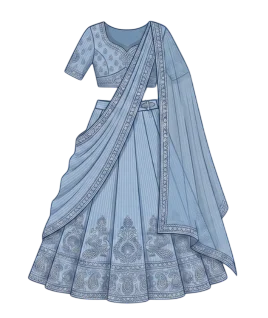
| Lehenga | 10,000 |
| Lehenga Choli | 13,500 |
| Sharara Suit | 6,000 |
| Gharara | 6,000 |
| Saree Ready to Wear (Clip-on Saree) | 3,000 |
| Saree Ready to Wear with Petticoat | 5,000 |
| Ready Made Petticoat with Alteration | 1,500 |
| Custom Petticoat | 2,500 |
| Custom Petticoat With Fabric | 3,500 |
| Skirt | 2,000 |
| Formal Shirt | 2,000 |
| Formal Trouser | 2,500 |
| Blazer | 7,500 |
| Two Piece Suit | 10,000 |
| Three Piece Suit | 14,000 |
| Western Dress | 8,000 |
| Basic Gown | 8,000 |
| Fall Pico | 990 |
| Pico | 250 |
| Alteration Onward | 990 |
| Plus Size Garments Extra Fee | 499 |
| Garment | Premium Price |
|---|---|
| Shirt | 1,490 |
| Pant | 1,490 |
| Trouser | 1,490 |
| Coat | 6,390 |
| Waistcoat | 3,390 |
| 2 Piece Suit | 8,390 |
| 3 Piece Suit | 10,890 |
| Double Breasted Jacket | 6,690 |
| Double Breasted Suit | 8,890 |
| Tuxedo Suit | 9,390 |
| Tuxedo Jacket | 8,390 |
| Long Coat | 8,390 |
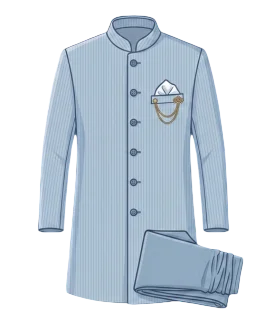
| Jodhpuri Bandhgala | 8,390 |
| Nehru Jacket | 3,890 |
| Indo Western | 10,890 |
| Sherwani | 10,890 |
| Safari Suit | 3,890 |
| Kurta | 1,990 |
| Kurta Pajama | 3,390 |
| Pathani | 2,390 |
| Pathani Kurta Pajama | 3,590 |
| Alteration | 999 |
This price list is only for customers from Delhi-NCR.
Please Note:
"Any Additional Design, Patterns, Heavy Embroidery Fabric Stitching & accessories will incur extra charges. These charges will be added to the total bill amount."**
All Payments are in ₹ INR
Price may be changed at any time without further notice
Terms and conditions applied**
Different clothing brands use different conversions between US/UK/EU sizes, so it’s difficult to give you a conversion chart that fits all situations. However, if you are looking for a particular size we can help you find the size for each brand. Please contact us with the item you are looking for and let us know what size you need.
There is no universal conversion between Asian and US/EU sizing. Depending on the brand, an identical measurement may have a different size. Generally speaking though Asian sizes run smaller.
It depends on the garment. For example, if it’s a structured blazer then we suggest getting the bigger size and getting it tailored. If it’s a stretchy t-shirt then you may be able to get away with the smaller size. If you’re unsure, get the bigger size.
Typically you’ll want to choose the bigger size to make sure it fits.
The best way to make sure you’re getting a garment that will fit is by using our sizing charts and measuring yourself. Below are tips on how to take your own measurements:
For pants, there are two types of measurements: “flat-lay” or body measurements. Flat-lay measurements are taken on the garment laid out on a flat surface, while body measurements are taken on the body.
Inseam is the measurement taken from the crotch to the ankle, running down the inside of the leg.
Outseam is the measurement taken from the waistband to the ankle, running down the outside of the leg.
Rise is the measurement from the crotch seam to the waistband. Sometimes rise is differentiated into front and back, and these measurements can be taken from the garment itself. They’re different because we’re not perfectly symmetrical from front to back.
Bust size: Wrap the measuring tape around the fullest part of your bust.
Underbust size: Wrap the measuring tape under your bust. This is the part of the bra that goes around your body. This measurement determines bra size. Cup size is determined by the difference between the bust and underbust.
Shoulder width is easiest to measure by having someone measure the distance from shoulder to shoulder in the back. If you’re doing it by yourself, you’ll want to have them mark the end of each shoulder and measure between the two. Checking in the mirror won’t work.
In addition to shoe length, shoe width can vary as well. Widths include Narrow, Medium (B/M), and Wide, such as D or E/EE. To find your width, stand with your full weight on the foot, have someone trace the outline, and then measure the width of the foot.
It can be difficult to take your own measurements accurately, but it’s important to take your time and make sure to get the most accurate measurements you can. Bodies aren’t perfectly symmetrical (tailors know this!). One side of your body is different than the other: shoulders, arms, legs, you name it. When it comes down to choosing a size, measure both sides of your body and use the size that fits the bigger side.
Believe it or not, our bodies aren’t consistent. Especially for the waist measurement, the circumference can change by 0.5-1.5” a day, depending on the amount and types of foods eaten, bloating, posture, etc. The best time to measure is in the morning for consistency.
Petite or tall sizing typically refers to body proportions in relation to height. They take into account torso length, arm/sleeve length, and/or inseam. Petite/tall sizes are independent of bust/waist/hip measurements.