PM
The fitting was spot on from first time and coat (unlined) falls perfectly on the shoulders. Overall it took 12 days. Very happy experience. Measured at my home at my home.
A ladies wool coat is the toughest garment of the season to get sewed correctly. Wool fabric can be very unforgiving. The thickness, unpredictable stretch and unforgiving nature of this material leaves no scope to hide any error of judgement in terms of sewing a wool coat.
Here at Tailorboutiques.com we provide doorstep tailoring service all over Delhi-NCR. We can tailor a well fitting ladies wool coat stitching for you.
The winters here are very short and the mornings have a real bite. Its important to own a well made, high quality wool coat which will stand the test of time. A garment which you would be using only 6 weeks in a year should be tailored to perfection and should be durable.
Here at Tailorboutiques.com, we measure, cut, sew and finish your custom made wool coats in-house and deliver it to your doorstep. All our tailors, karigars and fashion designers are in-house. Your fabric never visits another tailor’s shop.
Read on as we take you through the steps to sew a unlined/double faced wool coat. Use this information if you plan to tailor your garment by yourself or leave it all to us.
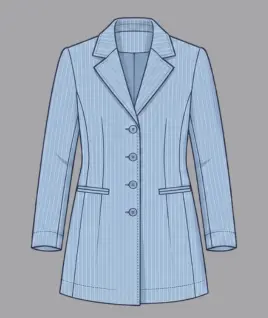








Real feedback from customers in Delhi-NCR and nearby areas.
The fitting was spot on from first time and coat (unlined) falls perfectly on the shoulders. Overall it took 12 days. Very happy experience. Measured at my home at my home.
A previous bad experience with my local tailor who ruined a coat had made me nervous about entrusting a beautiful double faced wool to a tailor. Each and every stitch on my coat is handmade. The quality is really wonderful. Worth the wait! Coat was delivered at my door step at Noida.
Quick and Neat Service. Sleeves length correction done at second fitting. No issues
Wool is heavy, thick, and temperamental. If you’ve ever worked with it, you know that. When making a simple shirt from lightweight cotton, minor mistakes can be easily corrected. That isn’t true for coats. Seams add to the thickness, darts create bust, shoulder or elbow shaping, and ironing mistakes can leave marks on the finished garment.
There’s more to consider when selecting your fabric. This is where double-faced wool comes in.
Double faced wool is a two layered fabric with both sides looking finished, this means that we don’t have to line the luxury unlined coat! Unfortunately that also means all seams will be on view.
Splittable Double-Cloth Construction –
Splittable Double-Cloth Construction, along each seam we separate the splittable layers, trim one of them down and turn the other one over and hand sew the seams closed.
Double-Cloth Layer Separation –
Using a sharp craft scalpel we carefully cut the tie-threads in between the layers without compromising the weave. This is the key skill learnt in Double-Faced Wool Coat Construction and Couture Outerwear Tailoring.
There are an almost unlimited number of coating fabrics, ranging from boiled wools to double-sided bonded wools. The selection of fabrics for coats depends on several characteristics, including drape and weight. Always test for drape to make sure if you want a loose drape you’re not getting something too stiff (or vise-versa).
Care must also be taken to properly prepare fabrics to account for shrinkage (particularly differential shrinkage in which the two wools in bonded fabrics shrink at different rates). Never cut and sew on fabric that hasn’t been steamed. Make sure to match grain lines and plan for layout considering direction of nap so that different parts of the garment won’t vary in shade.
Once you’ve got your materials together and prepared it’s a matter of following a particular sequence to build the coat.
1. In the drafting step pattern pieces are cut accordingly to the measurements of the person the coat is being made for. In case you are using a commercial pattern make sure that the pattern pieces have seam allowance. It is 5/8” (1.5 cm).
Now since we are making the coat of double cloth we will be adapting our patterns by following the method Pattern Seam Allowance Recalculation and reducing the seam allowance to 1/4” (5 mm).
2. Transfer the stitching line and notches on the main fabric with the help of thread tracing and chalk marking.
3. Use 90/14 size needle for machine stitching on double thickness of wool.
Join the coat and pocket pieces with Three stitch method for perfect tailored seams i.e. basted at ½” (10 mm) from raw edge, second stitch will be with a help of guide attached on sewing machine at 2.5 mm distance from third and last line of stitching.
Reduce the seam allowance to 2 to 3 mm.
4. Stitch the raw edges with waxed silk thread using Ladder stitch 3–5 mm apart.
Hand finishing can also be done with invisible slip stitching method.
5. Attach interfacing at shoulder seams for better fall of garment. We used twill stay-tape 1/4” (6 mm) wide for this step.
Attach fusible interfacings to reduce the bulk as shown in diagram. In case of this coat interfacings were limited to neck line area and button area only.
Cut a piece of felt (sleeve head) about 1.5” X 6” (4 cm X 15 cm) for each sleeve cap.
6. Next step is detailing of coat which includes welt pocket, patch pocket, bound button hole, lapel & roll line, kick pleat, belt and loop.
7. Hemming the edges of the coat and the sleeves.
For edges finishing/pressing (setting the edges with tailor’s touch) press cloth, clapper (wooden mallet), seam roll and tailor’s ham will be of great use.
Note : Karigars at our workshop follow all above steps as each step leads to the next one so rushing through any one of them will reflect on the following step.
We create Wool Coats and women’s outerwear in a variety of styles. Have a look below to get an idea of the sort of coats we create and the customisation options we provide.
Wool Coat – in a classic, fitted or relaxed cut
Double-Faced Wool Coat – finished on both sides
Unlined Wool Coat – light and simple inside
Unlined Double-Faced Wool Coat – seams finished by hand
Raglan Sleeve Wool Coat – to wear comfortably over jumpers
Set-In Sleeve Wool Coat – for a more defined line
Couture Wool Coat – cut to your measurements
Hand-Finished Wool Coat – edges and hems finished by hand
Double-breasted Wool Coat – made to order
Double-Cloth Cape/Wrap – Wool Outerwear in abundance
Unlined Wool Jacket – Wool Outerwear for milder winters
Other Wool Outerwear styles made on request.
We also offer an alterations service, to shorten your coat, adjust the sleeves or sides and Seam Repair. Traditional tailoring methods and couture techniques are employed in our tailored sewing to achieve a professional finish.
An unlined coat is lighter in weight and the insides are neater, and each and every edge has to be perfect! If warmth is a consideration or you would like your coat to easily slip over a sweater than a lined coat might be the best option for you. Heavier weight cloths lend themselves to be lined but a lighter weight, double-faced cloth might be better as an unlined coat. If you do choose a lined style we’ll cut lining pattern pieces out of a smooth lining (i.e. silk or acetate), pin it into position and close it by hand in the hem.
Raglan Sleeve Construction: Raglan sleeve has diagonal seam from collar to under arm. They don’t have shoulder pads and allow for very easy movement.
Set-In Sleeve Construction: This sleeve construction offers crisp shoulder. Depending on the sleeve head it has a smooth hang.
Next we clip the curves (2-3 mm apart) of the lapel and collar pieces. We then assemble the collar unit and the collar band. These are then assembled together. The pockets are added next (below are examples of both patch and side seam pockets).
Patch Pocket Construction: Pocket is tacked by 1/4 inch bar tack.
In-Seam Pocket Construction: The pocket opening is hidden in side seam.
Lastly we’ll add the belt and loops (if selected), a hanging loop and your choice of closings (i.e. concealed snaps, horn buttons, zips, etc…)
Stitching of Wool Coat can be done in easy steps.
1. Share your favourite styles of wool coat and fabric details by sending us message on WhatsApp at 8448448089.
2. Our designer will visit your home to take measurements at a convenient date and time in Delhi, Gurgaon, Noida, Greater Noida, Ghaziabad & Faridabad.
3. Choose from our range of fabrics OR bring your own fabric
4. Get a written estimate for the same before fabric is cut.
5. Our in house team will tailor your Wool Coat & visit for first fitting in approx 7 days.
6. Delivery at your doorstep after necessary corrections in remaining days.
Pricing for Wool Coat Stitching Service –
Wool coat stitching charges (without lining) start @ ₹7,500/-
Wool coat stitching charges (double faced) start @ ₹9,500/- onwards.
Hand Stitched/ Couture wool coat stitching charges start @ ₹15,000/- onwards.
Wool Coat alteration charges (hemming/ seam alterations) start @ ₹2500/- onwards.
Timelines –
Stitching timelines are 10 -14 working days.
Alterations timelines are 3 -5 days.
Tips –
Store your wool coats on a padded hanger in a cloth garment bag to let them breath. You could even keep a moth preventive cedar blocks to keep moths away. With good care, your coats will retain their shape and serve you for many years to come. If you find that one of the hand stitches has popped out, bring it to us, instead of trying to sew over it yourself.
| What matters | Tailorboutiques.com ⭐ | Typical local tailor |
|---|---|---|
| Who stitches | 👔 Our own tailors, karigars and designers | 👤 Often one tailor, sometimes outsourced |
| Measurements | 🏠 At your home | 🏬 At the shop |
| Double-faced wool | ✂️ Layers split and hand-finished in-house | ❌ Often sewn like an ordinary jacket |
| Fittings | 📏 Fittings at home | ⚠️ Usually one trial |
| Finish | ✨ Hand-finished seams, tailored pressing | ✖️ Machine finish |
| Delivery | 🚗 At your door | 🚶 You collect |
| Accountability | 📱 One team, one WhatsApp number | ❓ Varies |
| Garment | Premium Price |
|---|---|
| Kurti | 1,800 |
| Kurti with Lining | 2,000 |
| Suit with Salwar (Kurti + Salwar) | 3,000 |
| Suit with Salwar Half Lining (Lining in Kurti) | 3,200 |
| Suit with Salwar Full Lining (Kurti & Salwar Both Lining) | 3,500 |
| Suit with Pant (Kurti + Pant) | 3,000 |
| Suit with Pant Half Lining (Lining in Kurti) | 3,200 |
| Suit with Pant Full Lining (Kurti & Pant Both Lining) | 3,500 |
| Suit with Palazzo (Kurti + Palazzo) | 3,000 |
| Suit with Palazzo Half Lining (Lining in Kurti) | 3,200 |
| Suit with Palazzo Full Lining (Kurti & Palazzo Both Lining) | 3,500 |
| Blouse | 2,000 |
| Blouse with Lining | 2,500 |
| Princess Cut Blouse with Lining | 2,600 |
| Net Blouse with Lining (Three-Piece Blouse) | 3,500 |
| Blouse Padded | 3,500 |
| Net Blouse Padded (Three-Piece Blouse) | 4,500 |
| Anarkali Dress | 6,000 |
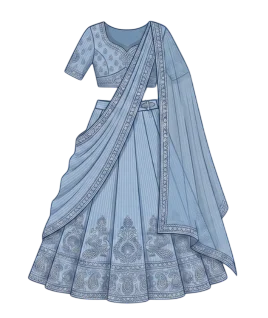
| Lehenga | 10,000 |
| Lehenga Choli | 13,500 |
| Sharara Suit | 6,000 |
| Gharara | 6,000 |
| Saree Ready to Wear (Clip-on Saree) | 3,000 |
| Saree Ready to Wear with Petticoat | 5,000 |
| Ready Made Petticoat with Alteration | 1,500 |
| Custom Petticoat | 2,500 |
| Custom Petticoat With Fabric | 3,500 |
| Skirt | 2,000 |
| Formal Shirt | 2,000 |
| Formal Trouser | 2,500 |
| Blazer | 7,500 |
| Two Piece Suit | 10,000 |
| Three Piece Suit | 14,000 |
| Western Dress | 8,000 |
| Basic Gown | 8,000 |
| Fall Pico | 990 |
| Pico | 250 |
| Alteration Onward | 990 |
| Plus Size Garments Extra Fee | 499 |
| Garment | Premium Price |
|---|---|
| Shirt | 1,490 |
| Pant | 1,490 |
| Trouser | 1,490 |
| Coat | 6,390 |
| Waistcoat | 3,390 |
| 2 Piece Suit | 8,390 |
| 3 Piece Suit | 10,890 |
| Double Breasted Jacket | 6,690 |
| Double Breasted Suit | 8,890 |
| Tuxedo Suit | 9,390 |
| Tuxedo Jacket | 8,390 |
| Long Coat | 8,390 |
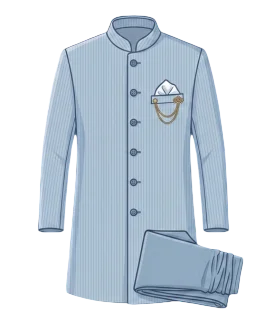
| Jodhpuri Bandhgala | 8,390 |
| Nehru Jacket | 3,890 |
| Indo Western | 10,890 |
| Sherwani | 10,890 |
| Safari Suit | 3,890 |
| Kurta | 1,990 |
| Kurta Pajama | 3,390 |
| Pathani | 2,390 |
| Pathani Kurta Pajama | 3,590 |
| Alteration | 999 |
This price list is only for customers from Delhi-NCR.
Please Note:
"Any Additional Design, Patterns, Heavy Embroidery Fabric Stitching & accessories will incur extra charges. These charges will be added to the total bill amount."**
All Payments are in ₹ INR
Price may be changed at any time without further notice
Terms and conditions applied**
Buttonholes with belts are usually tie belts and rarely need buttonholes. If you want to make bound buttonholes you will need to separate the layers of fabric for 1”/ 2.5 cm or so and finish the edges by hand so as to hide all raw edges. We strongly recommend that you try and make one on a fabric swatch first.
A good sharp pointy no.11 scalpel/craft knife comes in really handy for separating double faced fabrics. Karigars do it by hand because machines tend to tear the weave. You can also find a tool called a double cloth splitter. An embroidery snips is really helpful to snip any tie threads if there are any.
Use milliners needles size #9 or #10, with extra fine polyester thread or silk size 50. Silk thread we use at our workshop is waxed which helps them from tangling. You can wax polyester with bees wax.
You can use a very little at strategic places where the garment may benefit from the additional support. Cut out fusible interfacing in strips that are about 1/8”/ 3 mm smaller than the guideline/basting stitches. Interfacing would be required in areas such as shoulder, neckline, button stand and nowhere else. Never interface entire panels as it will change the fall of the fabric adversely. Always try interfacing on a small piece first before proceeding further.
This entirely depends on how the coat drapes. You may use invisible snaps for a clean look at the front or opt for some nice hefty horn buttons to bring the front down. Alternatively you can also use a zipper or heavy duty press snaps.
Adding twill stay-tape at shoulder and necklines is important to ensure that these do not stretch over time. If you want just a hint of structure at the sleeve head but don’t want a full on sleeve head you can add a thin woolen felt strip alongside the stay tape on the shoulder seam. Fold the strip into one-third and two-thirds sections with the middle third matching the shoulder seam and hand stitch on both sides to the facing.
Yes welt pockets, in seam or patch pockets can be added using acetate or silk for the pocket bags. It is better to chalk mark them out before cutting the fabrics.
There isn’t an easy way to do it but remember to reduce the seam allowance to 1/4”/ 5 mm throughout to compensate for the two thicknesses of fabrics. This is important for the seams to lie flat when turned to the wrong side. Once you reduce the seam allowances from the usual 5/8”/ 1.5 cm seam allowances remember to recheck the pattern pieces as it affects the fit.
Use a seam ripper to open about ½”/10 mm on either side of where it has come undone. Thread a needle with similar colour thread and ladder stitch the two ends back together matching tension so that it is even.
We welcome such queries, write to us on WhatsApp! We are open to custom orders, write to us for more! We mend clothes irrespective of whether we made it, write to us for more!
Message us on WhatsApp – 8448448089. Tell us the design and fabric, and we will schedule a home measurement appointment at your convenience. Our team will tailor, fit and deliver your coat, from the first stitch to your door.
We serve all cities in the NCR. Pick yours below.